| DECLINATION LINES |
The free booklet Declining Shadows (and its DeltaCAD
macro (calendarDeclination.bas) here, and you can set the
declination values) are very well worth downloading. This
is only an extract from the section in Illustrating Times
Shadow which deals with calendar curves in depth, and
discusses several trigonometric approaches, and provides
complete tables for a wide range of style heights
(latitudes). Also see here.
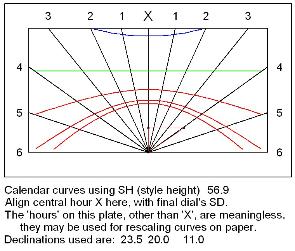
The DeltaCAD programs display calendar curves, as does
one of the JustBASIC programs, and of course the main
spreadsheet illustratingShadows.xls which has many ways
of calculating declination line data.
The DeltaCAD macros provide for animation showing how
declination curves vary. They also show how they vary by
nodus to dial plate height, or, by style length. The results
appear inconsistent, but they are not, and as with all the
DeltaCAD animations, they are highly instructive.
macro (calendarDeclination.bas) here, and you can set the
declination values) are very well worth downloading. This
is only an extract from the section in Illustrating Times
Shadow which deals with calendar curves in depth, and
discusses several trigonometric approaches, and provides
complete tables for a wide range of style heights
(latitudes). Also see here.
The DeltaCAD programs display calendar curves, as does
one of the JustBASIC programs, and of course the main
spreadsheet illustratingShadows.xls which has many ways
of calculating declination line data.
The DeltaCAD macros provide for animation showing how
declination curves vary. They also show how they vary by
nodus to dial plate height, or, by style length. The results
appear inconsistent, but they are not, and as with all the
DeltaCAD animations, they are highly instructive.
| For other dial furniture, look at the Italian line page page |
| The main page here has online Visual Basic programs for declination curves |
The analemma page has excellent DeltaCAD macros discussing not just the analemma, but also the calendar
curves.
However, this calendarDeclination.bas macro allows you to specify the declination values to use for all the dials,
whereas the analemma.bas macro has fixed values except for a few cases.
The analemma uses the EOT (equation of time) together with the sun's declination to derive the analemma, and that
same declination is the basis for calendar curves. Actually, that is true for armillary, equatorial, polar and meridian
dials. For horizontal, vertical, and vertical decliners, the sun's azimuth and altitude are used as well. And those
analemma notes are helpful in understanding what is going on. Chapter 24 of Illustrating Time's Shadow is by far
the best description available. I think.
curves.
However, this calendarDeclination.bas macro allows you to specify the declination values to use for all the dials,
whereas the analemma.bas macro has fixed values except for a few cases.
The analemma uses the EOT (equation of time) together with the sun's declination to derive the analemma, and that
same declination is the basis for calendar curves. Actually, that is true for armillary, equatorial, polar and meridian
dials. For horizontal, vertical, and vertical decliners, the sun's azimuth and altitude are used as well. And those
analemma notes are helpful in understanding what is going on. Chapter 24 of Illustrating Time's Shadow is by far
the best description available. I think.
| For calendar curves on any hour angle dial with analemmas, check this page here. However, this calendar macro allows more flexibility on specifying declination values. |
| GOOD DECLINATIONS TO USE FOR REASONABLE SYMMETRY FOR THE AMBIGUOUS MONTHS 23.50 20 10 0 or 19 or 11 or 18 or 12 Jun, Dec Jan, May Feb, Apr Mar, Sep Jly, Nov Aug, Oct |
| For other dial furniture, look at the analemma page |