| F O R T R A N |
| programming JAVA sundials sun dials |
FORTRAN
(free system available from... see url below)
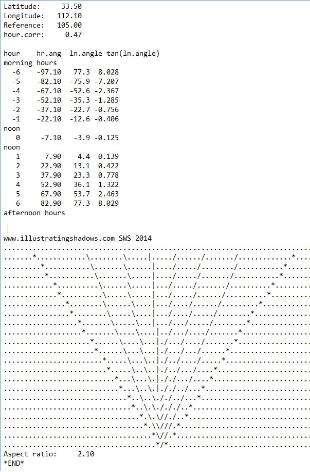
(a horizontal dial program
(and one using old time graphics :) )
The only free compiler and linker that I have been able to find after months of
search (meaning you will tell me of a million others!) is at:-
http://gcc.gnu.org/fortran/
While this is a free compiler, please note the desire of the providers to solicit
donations. This is a compiler, and a linker, and runs well. It installed first
time, has some manuals, and works. I have, as always, placed into my
notes the command line to compile, the command line to link (from object of
the compiler to an executable), and my notes also have a batch file to do it
all, and it begins with editing the program, then compiling, then linking, then
running, then viewing the output.
This is part of my battle to bring back the legacy languages so diallists can
have fun with their journey into gnomonics. Als it is part of my battle to bring
back sense into languages used for automation. FORTRAN having been
around longer than I have been in programming, and that started in the mid
60s for me.
Download these notes on how to get the free compiler, how to run it, and
also the zip file which has the source, object, executable, and the notes.
Simon's FORTRAN notes These use my PBE model of programming, see
below. This has the code and how to download the compiler,
how to download a good FORTRAN language manual,
how to compile, how to link (just like in the good old
days of linkage editors), and how to run it. (notes
improved)
Simon's notes and program In ZIP format this is the notes as above, plus
the source code, as well as the object deck (intermediate
file between compiling and linking to make the
executable), and the executable
file.
___________________________________________________________
PBE model of programming ~ ~ ~ (programming by example).
This section continues the "PBE" philosophy, namely "Programming By
Example". Having started programming in 1966, and having written code for
BAL, PL/I, RPG, COBOL, ALGOL, APL, FORTRAN, C, BASIC, C++, and for
operating systems from mainframe DOS, MFT, MVT, VS1, MVS, GCP (under
VM), UNIX, and various PC operating systems, I have become jaded enough
to wade right in and see what works, rather than read several hundred
pages of text that mix the language with the object oriented concepts with the
development system. PBE it is.
FORTRAN is typed, so work has to be done to explicitly convert REAL to
INTEGER, etc.
This system, like the PASCAL and the C++ systems on this web site,
produce simple executables that can be sent as is, and run. The
executables do not need a million support files, and the source code isn't
scattered all over creation. Unlike the Visual BASIC and the JAVA systems.
ALSO ~ ~ ~ Another way of playing with FORTRAN II is to use the IBM
7094 simulator, see this page, which is small to download, and if you use
my 7094 zip file, you get an h-dial program in FORTRAN II and the system is
fun.
(free system available from... see url below)
(a horizontal dial program
(and one using old time graphics :) )
The only free compiler and linker that I have been able to find after months of
search (meaning you will tell me of a million others!) is at:-
http://gcc.gnu.org/fortran/
While this is a free compiler, please note the desire of the providers to solicit
donations. This is a compiler, and a linker, and runs well. It installed first
time, has some manuals, and works. I have, as always, placed into my
notes the command line to compile, the command line to link (from object of
the compiler to an executable), and my notes also have a batch file to do it
all, and it begins with editing the program, then compiling, then linking, then
running, then viewing the output.
This is part of my battle to bring back the legacy languages so diallists can
have fun with their journey into gnomonics. Als it is part of my battle to bring
back sense into languages used for automation. FORTRAN having been
around longer than I have been in programming, and that started in the mid
60s for me.
Download these notes on how to get the free compiler, how to run it, and
also the zip file which has the source, object, executable, and the notes.
Simon's FORTRAN notes These use my PBE model of programming, see
below. This has the code and how to download the compiler,
how to download a good FORTRAN language manual,
how to compile, how to link (just like in the good old
days of linkage editors), and how to run it. (notes
improved)
Simon's notes and program In ZIP format this is the notes as above, plus
the source code, as well as the object deck (intermediate
file between compiling and linking to make the
executable), and the executable
file.
___________________________________________________________
PBE model of programming ~ ~ ~ (programming by example).
This section continues the "PBE" philosophy, namely "Programming By
Example". Having started programming in 1966, and having written code for
BAL, PL/I, RPG, COBOL, ALGOL, APL, FORTRAN, C, BASIC, C++, and for
operating systems from mainframe DOS, MFT, MVT, VS1, MVS, GCP (under
VM), UNIX, and various PC operating systems, I have become jaded enough
to wade right in and see what works, rather than read several hundred
pages of text that mix the language with the object oriented concepts with the
development system. PBE it is.
FORTRAN is typed, so work has to be done to explicitly convert REAL to
INTEGER, etc.
This system, like the PASCAL and the C++ systems on this web site,
produce simple executables that can be sent as is, and run. The
executables do not need a million support files, and the source code isn't
scattered all over creation. Unlike the Visual BASIC and the JAVA systems.
ALSO ~ ~ ~ Another way of playing with FORTRAN II is to use the IBM
7094 simulator, see this page, which is small to download, and if you use
my 7094 zip file, you get an h-dial program in FORTRAN II and the system is
fun.
| download Programming Shadows, it is free, and has many hints to get you up to speed on many languages |